p.s. I'm going to write a season report pretty soon on our 2012 rally journey

Wednesday, December 12, 2012
Another rally onboard
Just want to share this onboard video from our recent rally in Jempol, Negri Sembilan, Malaysia during the final round of Malaysian Rally Championship 2012. We got our best result so far, a podium finish and its a second overall. We also won the 2WD and class P10 (1600cc) in this round making us 2WD and class P10 champion, and third overall in the championship. Without further a due, please enjoy our onboard video.
p.s. I'm going to write a season report pretty soon on our 2012 rally journey
p.s. I'm going to write a season report pretty soon on our 2012 rally journey
Sunday, November 25, 2012
MRC 2012 Points Standing
I noticed that MalaysianRally.com website is still showing the same points standing since Round 2: Perlis and worst of all, its still provisional. To save everyone's trouble of guessing what the latest points standing are now, I took the trouble to myself and did the calculation. To my surprise, the points standing for overall and team's point are closer than I had imagine. It will be a battle to the last round, and that is what spectators love to see.
Just to cock tease you for a while more, I will explain how the point system for Malaysian Rally Championship (MRC) work before I reveal the points standing. I will only demonstrate how the overall is calculated. The method to calculate for other classification is roughly the same, with the difference of only classified competitors are taken into account during the calculation.
This is the points standing as of Round 2.

This is the result of Round 3

Points are awarded to the official finishing position at the rally, thus, the 10, 8, 6, ..... points awarded. Thus,
Nathan gets 10, Brian 8, Karam 6, etc.
I'm not done yet. MRC also award bonus point for the top 3 finisher of each leg, 3,2 and 1 point respectively which means Karam gets 3 points for Leg 1 and 1 point for Leg 2, Brian gets 2 points for each Leg 1 and 2, etc.


But again, I'm not done yet. Just like any other organizer around the world would do, there is always a catch somewhere. The regulation says that the competitor must compete in at least four rounds out of the five to be held this year. Else, points awarded will not be eligible for the championship, with the exception of team manufacturer's point. I'm unsure if the organizer will reconsider this rule since one round was cancelled. They might just change it to a minimum of three rounds out of the four rounds or remain it at a minimum four as though the cancelled is still taken into consideration. I'm just going to sort everything out by the total points disregard of the number of rounds competed.
So folks, I now present to you the provisional points standing as of Round 3.
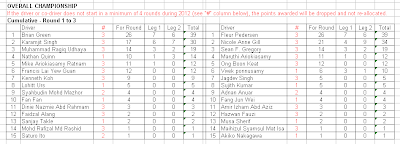
P.s*: Do not hold me responsible for any miscalculation, if any, as I have clearly mentioned this is only provisional points standing
**: I'll try to come up with the rest of the points standing by next week if malaysianrally.com doesn't update theirs.
Just to cock tease you for a while more, I will explain how the point system for Malaysian Rally Championship (MRC) work before I reveal the points standing. I will only demonstrate how the overall is calculated. The method to calculate for other classification is roughly the same, with the difference of only classified competitors are taken into account during the calculation.
This is the points standing as of Round 2.

This is the result of Round 3

Points are awarded to the official finishing position at the rally, thus, the 10, 8, 6, ..... points awarded. Thus,
Nathan gets 10, Brian 8, Karam 6, etc.
I'm not done yet. MRC also award bonus point for the top 3 finisher of each leg, 3,2 and 1 point respectively which means Karam gets 3 points for Leg 1 and 1 point for Leg 2, Brian gets 2 points for each Leg 1 and 2, etc.

Top positions of Leg 1

Top positions of Leg 2
But again, I'm not done yet. Just like any other organizer around the world would do, there is always a catch somewhere. The regulation says that the competitor must compete in at least four rounds out of the five to be held this year. Else, points awarded will not be eligible for the championship, with the exception of team manufacturer's point. I'm unsure if the organizer will reconsider this rule since one round was cancelled. They might just change it to a minimum of three rounds out of the four rounds or remain it at a minimum four as though the cancelled is still taken into consideration. I'm just going to sort everything out by the total points disregard of the number of rounds competed.
So folks, I now present to you the provisional points standing as of Round 3.

P.s*: Do not hold me responsible for any miscalculation, if any, as I have clearly mentioned this is only provisional points standing
**: I'll try to come up with the rest of the points standing by next week if malaysianrally.com doesn't update theirs.
Wednesday, November 14, 2012
CBT feat 'Ong Lai'
~That sounded weird, 'ONG LAI' or 'pine.ap.ple [pahy-nap-uh]' or 'prosperity come' to the Hokkien-lang~
Oh shoot, this is getting nowhere. Haha, I'm not really good at writing press format. I think I better stick to casual blog stories.
It was great having Grace Chen to do this cover for us. During the photoshoot, she made us felt like we're having our welding photo album taken. Like they always say, driver and co-driver relationship is like husband and wife in the car. Anyhow, I'll let Grace do the talking with her column :)
Source: http://www.cbt.com.my/2012/11/12/francis-lai-and-ong-boon-keat-partners-at-the-wheel/

KUALA LUMPUR, 3rd Nov 2012: Ong got a call from Grace asking if team D24 were interested to be featured in this coming weekend (12th Nov) NST's pullout, the Cars.Bikes.Trucks. Ong replied, Lai.
They then made a few more phone calls and a quick arrangement with MRU Motorsports, D24 soon got themselves and their car ready to meet up with Grace.
Balan, one of the race engineer got up early on the day of the photoshoot to wash the car and wax it to look good for the paper. Ong and Lai got off work early to fit in this appointment, a chance that they have been waiting for quite some time.
....
Oh shoot, this is getting nowhere. Haha, I'm not really good at writing press format. I think I better stick to casual blog stories.
It was great having Grace Chen to do this cover for us. During the photoshoot, she made us felt like we're having our welding photo album taken. Like they always say, driver and co-driver relationship is like husband and wife in the car. Anyhow, I'll let Grace do the talking with her column :)
Source: http://www.cbt.com.my/2012/11/12/francis-lai-and-ong-boon-keat-partners-at-the-wheel/
D24 in Me & Motors
Tuesday, November 13, 2012
Keng's recipe: Guide to a crispy pace notes
'How can you drive blindly so fast on roads that you've never driven before?' - I get this question a lot from friends when they found that I drive rally cars. I would answer them, no, I don't drive blindly, not literally at least 'coz we have a recipe, a recipe called crispy pace notes.

The two main ingredients of making a pace notes are one cup of distance and three spoonful of corner severity. Distance is how far is the next corner in meters while corner severity is the angle of corner, much like the needle of a clock.
If all I get from them is a blur face, I'd stop right there. But if they say, "I want more!", I tell them to read on ... :)

Before I started rallying, I used to think that there would be arrows displayed on the windscreen telling you what corners are coming up ahead. It's like what you'd find in Sega Rally, yeah, you remember that game don't ya?

What you need now is a steering marker. I'm sure most of you recognize this as the yellow strip on a Momo or Sparco steering, or from the in-car view for you RBR gamers. The marker is situated permanently at the 12 o'clock position of the steering wheel. If your steering don't have this, you can always make one by wrapping a masking tape at the top center.


For my pace notes, I use a 1 to 6 range, 6 being a fast corner. What I'll do is I'll mark the position of these numbers on the steering wheel and a center reference point on the dashboard. I don't mark +/- on the wheel as fewer markers makes the reading a lot quicker, you don't need that much effort to read the numbers written on it, just a quick glance will do ~ Trust me, you'll get bored and exhausted when you do an over 30km stage notes and you'll want to keep things simple.


All you need to do next is drive down the stage and keep to the middle of the road. Mark down the distance you started from one corner to the other in meters. Once you've reached a corner, steer into the corner so that the 12 o'clock marker is pointed to the corner. Now, look at the marker's number on your wheel that is inline with your reference center point on the dashboard. This your corner severity.


Another way of doing it is to mark on the dashboard instead. Your steering wheel will still have the marker at the top center BUT your severity markers will be on the dashboard. Drive down a stage and instead of reading your steering, you're now reading the number on your dashboard. The cons about this method is you don't always get a rental car with the perfect shaped dashboard that allows you to do this. I don't use my own car for recce, thus, I don't have the luxury to choose what kinda of dashboard I want and even if I do, chances are I won't get the same make & model of recce car the next time I drive one.

Some drivers are more comfortable with descriptive corner like fast/medium/slow which is more like a speed notes rather than a pace notes. I can't say if there is no good or bad pace note system, its a good system as long as they work for you. We do adopt some of the speed notes style which IMO is easier if you can estimate what speed you'll be doing later at rally time during the recce.
I refer a lot to onboard videos of the late great Colin McRae and Markko Martin for my pace notes. Both of them uses the numberative corner severity with easy to listen additional notes. With abundant videos on YouTube, and their flamboyant style of driving, it makes learning process so much fun. I would listen to Grist and Beef's calls on my earphone during working hours just to get myself into the 'zone' prior to a rally.
I took a lot of advice during the early years by going with the most basic pace notes system and slowly worked our way up from there. I can say that although its been three years, I still find myself trying to improvise the pace notes to allow us to drive faster and of course, safer.
So that my friends, is how you make a crispy pace notes :)
p.s. There are a lot of things I want to share but that'll make this entry too long, I'll be sharing more advance notes and probably things of do's and don'ts of recce.

The two main ingredients of making a pace notes are one cup of distance and three spoonful of corner severity. Distance is how far is the next corner in meters while corner severity is the angle of corner, much like the needle of a clock.
If all I get from them is a blur face, I'd stop right there. But if they say, "I want more!", I tell them to read on ... :)

Before I started rallying, I used to think that there would be arrows displayed on the windscreen telling you what corners are coming up ahead. It's like what you'd find in Sega Rally, yeah, you remember that game don't ya?

Not exactly this arrow but you get my drift

1/2" masking tape & marker pen

Make a roll around the grip of the wheel, press them firmly as they tend to move if the surface doesn't stick

Now a tape on the dashboard as the center reference point
For my pace notes, I use a 1 to 6 range, 6 being a fast corner. What I'll do is I'll mark the position of these numbers on the steering wheel and a center reference point on the dashboard. I don't mark +/- on the wheel as fewer markers makes the reading a lot quicker, you don't need that much effort to read the numbers written on it, just a quick glance will do ~ Trust me, you'll get bored and exhausted when you do an over 30km stage notes and you'll want to keep things simple.

Start with from top & work down from there

You can do all the way down to 1. You might notice that the larger numbers have lesser degrees between them, that's how important fast corners are ;)
All you need to do next is drive down the stage and keep to the middle of the road. Mark down the distance you started from one corner to the other in meters. Once you've reached a corner, steer into the corner so that the 12 o'clock marker is pointed to the corner. Now, look at the marker's number on your wheel that is inline with your reference center point on the dashboard. This your corner severity.

Turn the wheel until the center marker points (not your front tires) to the corner

And there you have it, the number at the top center is the corner severity. Repeat this for 1,000 times.
Another way of doing it is to mark on the dashboard instead. Your steering wheel will still have the marker at the top center BUT your severity markers will be on the dashboard. Drive down a stage and instead of reading your steering, you're now reading the number on your dashboard. The cons about this method is you don't always get a rental car with the perfect shaped dashboard that allows you to do this. I don't use my own car for recce, thus, I don't have the luxury to choose what kinda of dashboard I want and even if I do, chances are I won't get the same make & model of recce car the next time I drive one.

How the hell am I going to mark this dashboard?
Some drivers are more comfortable with descriptive corner like fast/medium/slow which is more like a speed notes rather than a pace notes. I can't say if there is no good or bad pace note system, its a good system as long as they work for you. We do adopt some of the speed notes style which IMO is easier if you can estimate what speed you'll be doing later at rally time during the recce.
I refer a lot to onboard videos of the late great Colin McRae and Markko Martin for my pace notes. Both of them uses the numberative corner severity with easy to listen additional notes. With abundant videos on YouTube, and their flamboyant style of driving, it makes learning process so much fun. I would listen to Grist and Beef's calls on my earphone during working hours just to get myself into the 'zone' prior to a rally.
I took a lot of advice during the early years by going with the most basic pace notes system and slowly worked our way up from there. I can say that although its been three years, I still find myself trying to improvise the pace notes to allow us to drive faster and of course, safer.
So that my friends, is how you make a crispy pace notes :)
p.s. There are a lot of things I want to share but that'll make this entry too long, I'll be sharing more advance notes and probably things of do's and don'ts of recce.
Thursday, July 5, 2012
A day at Sepang with Clubsport
We went for our first open track day couple of months back at the infamous Sepang International Circuit. It's actually a Honda Open Track Day but a good friend of ours managed to get us a slot and boy are we glad that we didn't give it a miss.
Our weapon of choice was a limited edition Proton Satria Neo Clubsport. Not gonna explain much about this car now as a plan to review it is already on its way. The owner was kind enough to hand over the keys to us coz he was at work in the middle of a desert. This car also doubles as our practice car as you can probably tell by the steering marker in the video. Our usual rally machine is Proton Satria Neo with a MIVEC heart meanwhile this still keeps the factory CAMPRO engine. The power delivery is smoother though less peaky and has a standard ratio box without LSD. Please bear with us as we didn't clock the expected laptime, what do you expect from a rally driver? :P
Our weapon of choice was a limited edition Proton Satria Neo Clubsport. Not gonna explain much about this car now as a plan to review it is already on its way. The owner was kind enough to hand over the keys to us coz he was at work in the middle of a desert. This car also doubles as our practice car as you can probably tell by the steering marker in the video. Our usual rally machine is Proton Satria Neo with a MIVEC heart meanwhile this still keeps the factory CAMPRO engine. The power delivery is smoother though less peaky and has a standard ratio box without LSD. Please bear with us as we didn't clock the expected laptime, what do you expect from a rally driver? :P
Subscribe to:
Posts (Atom)